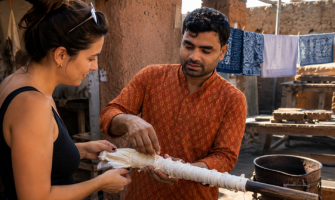
Walk through any market in Jaipur and a dupatta or turban will stop you mid-step — small dots scattered like tiny stars, or stripes rippling across the cloth like water. This is tie and dye, one of Rajasthan’s oldest textile crafts, and the interesting part is that none of that colour is painted or printed on. The pattern comes from what the dyer stops the colour from reaching.
This guide covers how tie and dye actually works, the difference between Bandhani and Leheriya, the other tie dye techniques used across Rajasthan, and where all of this fits alongside Bagru and Sanganer’s better-known block printing crafts.
Table of Contents
- What Is Tie and Dye?
- History of Tie and Dye in Rajasthan
- How Does the Tie and Dye Process Work?
- Traditional Tie and Dye Techniques of Rajasthan
- Natural Dyes Used in Traditional Tie and Dye
- Bandhani vs Leheriya: What’s the Difference?
- Tie and Dye vs Bagru Block Printing
- Tie and Dye, Bagru and Sanganer: Rajasthan’s Textile Heritage
- Why Traditional Resist Dyeing Still Matters
- Experience Traditional Textile Techniques in Rajasthan
- FAQs
What Is Tie and Dye?
Tie and dye is a form of traditional resist dyeing — the fabric is tied, folded, twisted or knotted before it goes anywhere near the dye. Whatever part of the cloth is bound up stays protected. Everything left exposed soaks up the colour. Once the threads are removed, the pattern that was hiding underneath finally shows itself.
That’s really the whole idea, and it’s also why the common search term “tie dye printing” is a bit of a misnomer, even though a lot of people use it. Nothing is actually printed here — no block, no stamp. The design comes entirely from how the fabric itself is handled before dyeing, which makes tie resist dyeing a genuinely different craft from block printing, even though both sit under Rajasthan’s much wider umbrella of resist-dyeing traditions.
It’s also worth saying upfront: tie and dye isn’t a niche or dying craft. Walk into almost any wedding hall, festival or family function in Rajasthan and you’ll spot Bandhani or Leheriya somewhere in the room — on a dupatta, a saree pallu, a turban, or a scarf draped over someone’s shoulder. It’s woven into daily life here, not locked away in museums.
History of Tie and Dye in Rajasthan
Rajasthan tie dye goes back a long way — tying and dyeing cloth by hand has been practised in India for centuries, with some of the earliest evidence coming from old paintings that show figures dressed in dotted, speckled fabric. Over generations, Rajasthani tie dye developed its own distinct styles, separate from how the craft evolved in other parts of the country.
The artisan community traditionally associated with this craft is often referred to as the Rangrez — a word that simply means “those who dye fabric.” Families from this community have passed the skill of tying and dyeing down through generations, and in many cases, the exact patterns and colour combinations used are still specific to a particular family or workshop.
Jaipur Leheriya in particular carries a strong regional identity. Documentation from the National Institute of Design’s D’Source project records Leheriya as a tie-and-dye tradition closely tied to Jaipur, where the cloth is twisted, wrapped around a wooden pole, and tied at regular intervals before it’s dyed.
Both Bandhani and Leheriya have long been part of everyday and festive Rajasthani dress — turbans, odhnis, dupattas, sarees and suits worn during weddings and celebrations, often with specific colours and patterns carrying their own meaning depending on the community, the season, or the occasion being celebrated.
How Does the Tie and Dye Process Work?
The exact steps shift a little depending on whether an artisan is making Bandhani, Leheriya or another variation, but the basic tie and dye process looks like this:
1. Washing and Preparing the Fabric
The cloth — usually cotton or fine silk — is washed first to remove starch or dust that could stop the dye from taking evenly. Fabric that isn’t cleaned properly ends up with patchy, uneven colour once it’s dyed, so this step matters more than it looks like it should.
2. Marking or Folding
For Bandhani, tiny points are marked out across the fabric, sometimes with a printed grid as a guide so the dots line up into a recognisable pattern. For Leheriya, the cloth is folded diagonally and rolled tightly along its length instead, with no dot-marking involved at all.
3. Tying the Resist Points
This is the most skilled part of the whole craft. In Bandhani, artisans pinch and tie hundreds, sometimes thousands, of tiny points by hand, often using a long fingernail to lift each pinch of cloth before wrapping thread around it. In Leheriya, the rolled fabric is tied at set intervals along its length, which is exactly what creates the wave pattern once it’s opened out. Both methods demand a steady hand — too loose a tie and the dye seeps through; too tight and the fabric can tear.
4. Dyeing
The tied fabric goes into the dye bath. Multi-coloured pieces are dyed more than once, with fresh ties added between rounds to protect the colours already achieved, working from the lightest shade to the darkest.
5. Drying With the Ties Still On
The fabric dries with the knots left in place, keeping the pattern locked in until the artisan is ready to open it. Depending on the weather, this can take anywhere from a few hours to a couple of days.
6. Untying
The threads are picked out slowly by hand — rushing this step can tear the fabric. It’s genuinely the most satisfying part to watch, since the hidden pattern shows itself for the first time here, dot by dot or fold by fold.
7. Washing and Finishing
One final wash removes any loose dye before the fabric is dried, pressed, and ready to become a dupatta, saree, suit piece, turban or scarf.
Traditional Tie and Dye Techniques of Rajasthan
Rajasthan isn’t home to just one tie-dye style — there are several distinct tie dye techniques, each with its own look and method.
Bandhani / Bandhej
Bandhani, also known as Bandhej, is probably the style most people picture first — small, tightly-packed dots that build up into bigger patterns like flowers, waves or geometric grids. Some of the more well-known dot arrangements even have their own names, passed down through generations of artisans.
Each dot is its own tiny knot, tied and dyed one at a time, which is exactly why a well-made piece takes so long and costs what it does. The craft shows up across a wide range of products in Rajasthan — sarees, suits, dupattas, scarves, odhnis and turbans are all commonly made this way, and it’s just as popular in everyday cotton wear as it is in more festive silk pieces. Such a piece is often bought specifically for weddings and festivals, since the dotted pattern has long been considered auspicious in Rajasthani and Gujarati households.
Leheriya
Leheriya (from lahar, meaning wave) looks completely different from Bandhani — instead of dots, you get diagonal stripes rippling across the cloth. That effect comes from rolling the fabric into a tight diagonal coil and tying it at intervals before dyeing, rather than tying individual points.
These pieces can carry anywhere from two to seven colours depending on how many times the cloth is dyed and retied, with multi-coloured versions considered more festive and more difficult to produce. It’s closely associated with Jaipur, and traditionally shows up on turbans, dupattas, sarees and scarves — a turban made this way used to be a standard part of formal Rajasthani menswear.
Mothra and Other Tie-Dye Variations
Mothra takes the wave pattern one step further — the fabric is tied and dyed diagonally in one direction, then again in the opposite direction, so the two sets of lines cross and form small diamond or checked shapes. It takes more time and far more precise tying than a single-direction Leheriya, and is generally considered the more advanced version of the technique. It’s most often turned into dupattas, sarees and turbans rather than heavier garments.
Natural Dyes Used in Traditional Tie and Dye
Traditionally, Rajasthan’s tie and dye craft leaned heavily on natural dyes drawn from plants, minerals and other natural sources rather than synthetic colour. Indigo has long been used for deep blues, madder root and similar plant sources for reds and pinks, and turmeric or other natural yellows for warmer tones — with combinations of these base colours used to build up the brighter, multi-coloured Leheriya and Bandhani pieces seen at weddings and festivals.
The exact shade an artisan gets depends on the dye source, the fabric, the water, and how the dye is prepared and fixed — which is part of why handmade tie-dye pieces rarely look perfectly uniform, and why that’s actually considered part of their charm rather than a flaw.
Today, many workshops and artisan setups use a mix of natural and synthetic dyes depending on the product and the colours needed, but the process of protecting fabric with ties before dyeing stays exactly the same either way.
Bandhani vs Leheriya: What’s the Difference?
| Feature | Bandhani | Leheriya |
|---|---|---|
| Pattern | Dots and small motifs | Diagonal wave-like stripes |
| Method | Small points pinched and tied individually | Fabric rolled diagonally and tied at intervals |
| Strongly associated with | Rajasthan | Jaipur, Rajasthan |
| Typical products | Sarees, suits, dupattas, scarves, odhnis | Turbans, dupattas, sarees, scarves |
Both are genuine tie resist dyeing techniques, and both are commonly grouped together as “Rajasthan tie dye” — but visually and technically, they’re built quite differently, and a trained eye can usually tell them apart from across a room.
Tie and Dye vs Bagru Block Printing
It’s easy to lump every colourful Rajasthani textile into one category, but these are genuinely separate crafts, made in completely different ways:
- Tie and dye (Bandhani, Leheriya, Mothra) creates its pattern by tying or folding the fabric itself before dyeing.
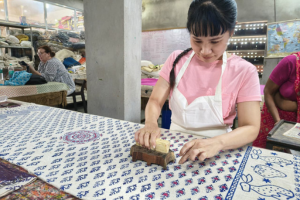
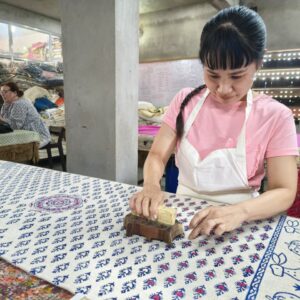
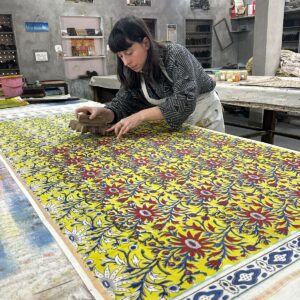
- Bagru block printing uses a hand-carved wooden block to stamp colour, pigment or resist paste directly onto flat fabric.
- Dabu printing, also from Bagru, is a mud-resist technique — a paste made from clay and natural materials is block-printed onto the cloth, and only the un-pasted areas take the dye.
Tie and dye and Dabu are both, underneath it all, forms of traditional resist dyeing — they just reach the same goal differently. One resists the dye using thread and knots, the other using a printed paste. Bagru’s block printing tradition, by comparison, is built around direct pigment or dye application through a carved wooden block, rather than protecting the fabric at all. Studios working in this tradition, like Anaprinta Textiles, generally specialise in this block-based side of Rajasthan’s craft world rather than the tying and knotting seen elsewhere in the state.
Tie and Dye, Bagru and Sanganer: Rajasthan’s Textile Heritage
Bagru and Sanganer, both near Jaipur, are two of Rajasthan’s best-known textile printing hubs — but each has built its own identity within the state’s wider craft heritage.
Bagru is known for its hand block printing, particularly natural dyeing and Dabu mud-resist printing, carried forward largely by the Chhipa community. Studios such as Anaprinta Textiles continue this tradition today, working with local artisans on hand-carved wooden blocks, natural dyes and mud-resist techniques.
Sanganer is known for its own detailed hand-block printed textiles, especially fine floral and botanical patterns.
Bandhani and Leheriya, on the other hand, sit under a different branch of Rajasthan’s textile world altogether — tie and dye rather than block printing — and are most strongly associated with Jaipur city itself, largely through Rangrez artisan families.
Seen together, these three centres aren’t really competing crafts — they’re different chapters of the same story: printing, dyeing and resist techniques that have grown side by side across Rajasthan for generations.
Why Traditional Resist Dyeing Still Matters
None of this survives by accident. Every dot in a Bandhani piece and every wave in a Leheriya one is still tied by hand — often by artisans from families who’ve done this work for generations — using skills that simply don’t transfer to a machine. A single such saree or dupatta can represent days of tying work before it even reaches the dye bath.
Choosing a genuine handmade piece, or spending time watching (or trying) the process yourself, is one of the more direct ways to support that continuity, especially with cheaper printed imitations now common in the market. A machine-printed dupatta can copy the look of dots in seconds; it can’t copy the slight irregularity that comes from a human hand tying each on.
Experience Traditional Textile Techniques in Rajasthan
If you want to actually see traditional resist dyeing rather than just read about it, it helps to know what’s available where.
Bandhani and Leheriya are practised by specialist artisan families based mainly in and around Jaipur city, and that’s where you’ll find the most authentic, hands-on experience with either craft — from tying your first dots to watching a wave-patterned turban unroll for the first time.
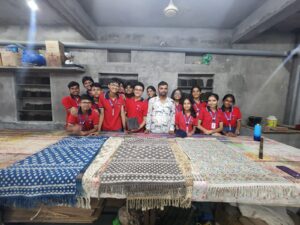
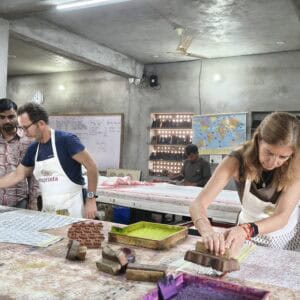
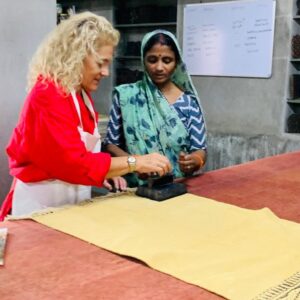
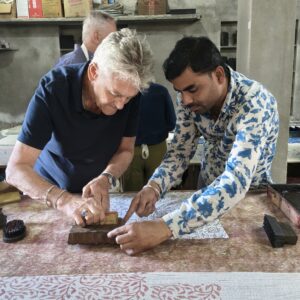
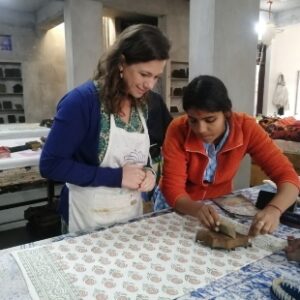
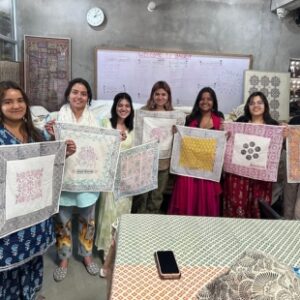
Bagru’s own craft identity, on the other hand, is built around hand block printing rather than this kind of fabric tying. At Anaprinta Textiles‘ studio in Bagru, visitors can join hands-on workshops covering:
- Pigment block printing (One-Day Workshop) — a good starting point for beginners
- Pigment printing combined with eco-printing (One-Day Workshop 2.0)
- Dabu mud-resist printing, natural inks like Syahi-Begar, and Indigo and Kashish dyeing (Two-Day Workshop)
- Pigment, natural, Dabu resist and Jahota/Shibori techniques together (Four-Day Workshop) — Jahota itself is a block-printing style (a blend of Dabu and Syahi-Begar), but Shibori, taught alongside it in this workshop, is a genuine fold-and-tie resist technique, which makes this the closest thing to tie and dye within Bagru’s own craft tradition
Learning Shibori Tie-Dye With the Anaprinta Family in Bagru
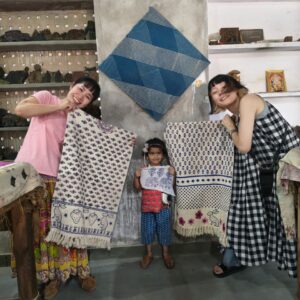
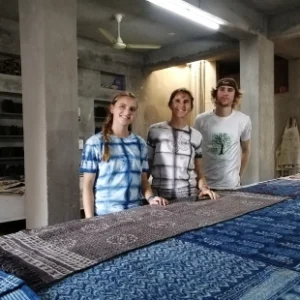
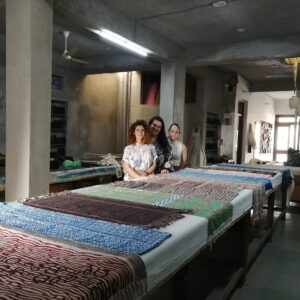
Anaprinta is run by Anup Chhipa, from a multi-generation family of Bagru block printers, and the Shibori portion of the Four-Day Workshop is taught personally by Anup and his family rather than handed off to outside instructors. Visitors who’ve documented their time at the studio describe being introduced to Shibori tie-dye alongside pigment printing over the course of their stay, working directly with Anup as well as his parents in the family’s home workshop in Chhipo ka Mohalla.
In practice, this means learning to fold, twist and tightly bind a length of cloth — usually a silk or cotton scarf — by hand, then watching it go through the dye bath before the ties come off and the pattern appears, the same underlying resist principle behind Bandhani and Leheriya, just taught here as a smaller, standalone skill rather than a full craft tradition of its own. It’s a hands-on way to understand why tying resists dye at all, before you go and see the far more intricate, generations-deep version of that same idea in Jaipur’s Bandhani and Leheriya work.
So it’s fair to say Bagru does have tie-dye — just the one type, Shibori, taught as part of a longer, block-printing-led workshop, rather than a native Bagru craft in its own right.
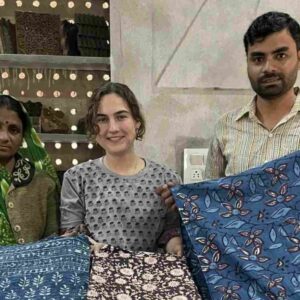
Beyond the workshops, Anaprinta also makes and sells its own hand block printed products — including cotton suit sets, kurtis and dress-material fabric — so if you’d rather take home a finished, block-printed piece instead of (or alongside) a tie-dyed one, that’s part of what the studio offers too.
So if your main goal is learning either of these specific crafts, Jaipur city is the better starting point. If you want a broader picture of Rajasthan’s resist-dyeing world — Dabu, indigo, natural inks, Jahota’s layered block work, and Shibori’s tie-resist technique — a workshop with Anaprinta Textiles in Bagru pairs naturally with a visit to Jaipur’s artisan families, and together they show just how differently the same basic idea plays out across the state’s textile crafts.
You can read more about Bagru’s own resist and dyeing traditions in our earlier posts on Syahi Begar, Rajasthan’s black and red printing art, and on natural indigo dyeing in Bagru — both part of the Two-Day Workshop mentioned above.
FAQs
What is tie and dye? Tie and dye is a traditional resist dyeing technique where fabric is tied, folded or twisted before dyeing, so the tied parts stay undyed and form the pattern once the ties come off.
What is the tie and dye process? Broadly: the fabric is washed, marked or folded, tied at specific points, dyed, dried with the ties still on, untied, and finally washed and finished. Multi-coloured pieces repeat the tying and dyeing steps more than once.
What are the different tie dye techniques? In Rajasthan, the main ones are Bandhani (dotted patterns), Leheriya (diagonal wave stripes), and Mothra (a crossed, checked variation of Leheriya made by tying and dyeing in two directions).
What is Bandhani? Bandhani, also called Bandhej, is a tie and dye technique where small points of fabric are individually pinched, tied and dyed to create dotted patterns, commonly seen on sarees, suits, dupattas and scarves.
What is Leheriya? Leheriya is a Rajasthani tie and dye technique, strongly associated with Jaipur, known for its diagonal wave-like stripes created by rolling and tying the fabric before dyeing.
Is Bandhani a tie and dye technique? Yes. Bandhani is one of the most well-known tie and dye techniques in Rajasthan, alongside Leheriya and Mothra.
What is the difference between Bandhani and Leheriya? Bandhani is made up of small individually-tied dots, while Leheriya is made by rolling the fabric diagonally and tying it at intervals, which creates stripes instead of dots.
Where is tie and dye famous in Rajasthan? Tie and dye, especially Bandhani and Leheriya, is most strongly associated with Jaipur, where specialist Rangrez artisan families continue to practise it today.
Is tie and dye a resist dyeing technique? Yes. Tie and dye is a form of traditional resist dyeing — the fabric itself is used to block the dye, rather than a printed paste or wax resist.
How many types of tie and dye are done in Bagru? Bagru’s own craft tradition is centred on block printing, not tie and dye, so it doesn’t have native tie-dye styles of its own like Jaipur’s Bandhani or Leheriya. The one tie-resist technique taught in Bagru is Shibori, offered as part of Anaprinta’s Four-Day Workshop alongside pigment, natural and Dabu resist printing.
Anaprinta Textiles is a hand block printing studio in Bagru, Rajasthan, offering hands-on workshops in pigment printing, Dabu resist, natural dyeing and Jahota/Shibori techniques, along with its own range of block printed suits, kurtis and fabric. Contact +91-9799474072 or visit us at 9, Namdev Colony, Lal Koti, Bagru, Jaipur — 303007.