Textile Manufacturing: From Fibre to Fabric (Anaprinta Blog)
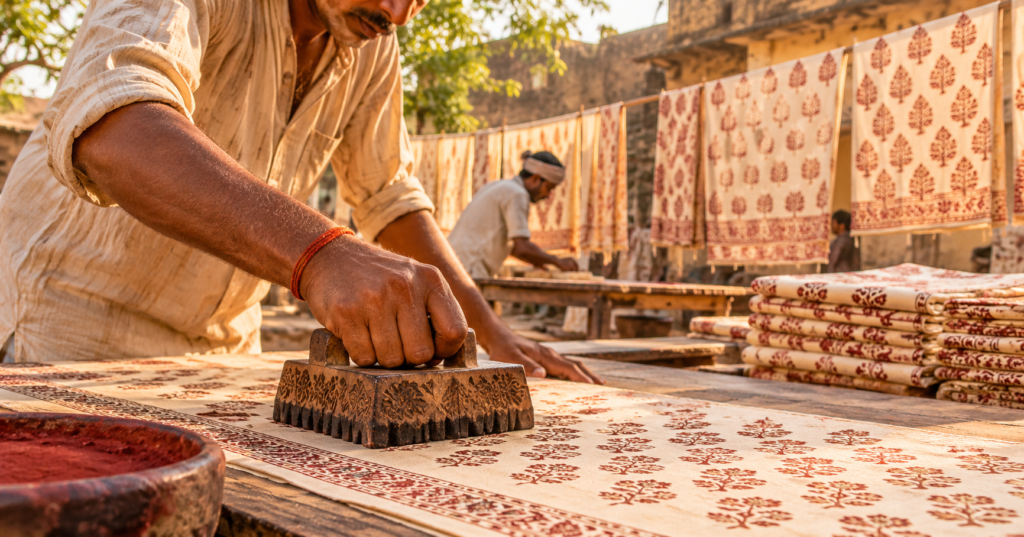
Every cotton scarf you wrap around your neck and every tablecloth you spread for Sunday dinner started as a field, a fibre or a bale of yarn. Textile manufacturing is the long chain of steps that turns that raw material into fabric, and then into the things we use every day. Some of it happens in huge mills where machines run around the clock. Some of it happens in a small courtyard in Rajasthan, where a printer presses a hand-carved wooden block onto cotton and lifts it with a soft thump. We belong to that second world. At Anaprinta Textiles in Jaipur, we make hand block printed cotton scarves, tablecloths and coasters, and ship them to homes in the USA, UK, Canada and many other countries. In this guide we will walk through how textile manufacturing works, how textile mills compare with handmade production, who the main United States textile manufacturers are, and why more buyers now prefer slow, handmade cloth. Whether you are a student, a small business owner, a buyer sourcing fabric, or just someone curious about where your tablecloth came from, this one is for you. What Is the Textile Industry? The textile industry is the worldwide network of businesses that grow or produce fibres, spin them into yarn, turn yarn into fabric, and then dye, print and finish that fabric. It also covers everything made from cloth afterwards: bedsheets, curtains, towels, car seats, hospital gowns and the cotton scarf in your wardrobe. That is why people often search for “textile and manufacturing” together. In practice you cannot separate the two. The industry has three broad layers: What surprises many readers is the range of scale. A large mill can weave thousands of metres of fabric in a single shift. A block printing family in Bagru might print a few hundred metres in a week. Both are textile manufacturing, and both have a place in the market. They just serve very different buyers. Textile Making: How Fibre Becomes Fabric Textile making follows the same basic path whether the cloth comes from an automated mill or a village workshop. Here is the journey of a cotton fabric, step by step. A big mill automates almost every one of these steps. A handmade studio like ours keeps the most skilled part, printing and finishing, in human hands. That single choice is what gives block printed cloth its slightly irregular, lived-in charm. Textile Mills: Where Scale Meets Speed Textile mills are factories that turn fibre into yarn or yarn into fabric. They shaped the modern world. Early mill towns such as Lowell in Massachusetts and Lancashire in England grew around water-powered looms, and Ahmedabad earned the nickname “Manchester of India” for its cotton mills. Most mills specialise in one stage: Mills are built for volume and consistency. If a buyer needs fifty thousand metres of identical grey cloth, a mill is the answer. If a buyer wants a tablecloth with an uneven, hand-pressed motif that nobody else has, a mill is the wrong tool. Here is how the two approaches compare. Textile mill Hand block printing studio Output Thousands of metres per day Limited batches, made by hand Consistency Every metre identical Small natural variations in every piece Customisation Needs large minimum orders Easy to adapt colours and motifs for small runs Look and feel Uniform, machine-perfect Textured, warm, one of a kind Best for Mass-market apparel and furnishings Gifts, home styling, heritage-minded buyers Neither is better in every case. They solve different problems. But for buyers who care about craft, handmade cloth offers something a mill line simply cannot. United States Textile Manufacturers: Who Makes What If you are searching for United States textile manufacturers, the first thing to know is that the industry is concentrated in the South. VerticalIQ notes that US textile production sits mainly in the southeastern states and Pennsylvania, with Georgia and North Carolina employing the largest textile workforces. A First Research industry profile adds that the 50 largest companies earn about 60% of industry revenue, while imports make up roughly 45% of the US textile market. It is also an industry that keeps investing. Textile World reports that US textile makers put $34.3 billion into advanced domestic manufacturing between 2017 and 2024. IBISWorld lists Elevate Textiles as the largest business in the sector and describes market share as spread thin across many players. A few well-known names, for orientation (check each company’s website for current details): Company Based in Known for Milliken & Company Spartanburg, South Carolina Performance textiles, flooring and specialty chemicals Unifi Greensboro, North Carolina Polyester and nylon yarns, including recycled yarn Culp High Point, North Carolina Mattress and upholstery fabrics Parkdale Mills Gastonia, North Carolina Cotton and synthetic yarns These companies are built for industrial buyers: apparel brands, furniture makers, automotive suppliers and medical product companies. They typically work with large minimum orders. What if you want something small-batch and handmade? That is where a studio like ours fits in. Home stylists, gift buyers, boutique owners and café owners in the USA, UK and Canada often want one tablecloth, a set of six coasters, or a scarf with a motif they will not see in a big-box store. Mills do not serve that need well. Our Etsy shop does. Textile and Manufacturing in India: Rajasthan, Jaipur and Bagru India is one of the world’s oldest textile countries, and today it runs both ends of the spectrum side by side: giant spinning and weaving mills in states like Gujarat and Tamil Nadu, and millions of handloom and hand-printing workers spread across villages. Cotton is at the centre of it all. Rajasthan’s contribution is colour. Around Jaipur, two printing towns stand out. Sanganer is known for fine, delicate floral prints. Bagru, about 30 km southwest of the city, is known for earthy, hand-pressed designs made by Chhippa families whose printing tradition goes back more than four hundred years, according to Daughters of India. Bagru printing has a few signature features: This is