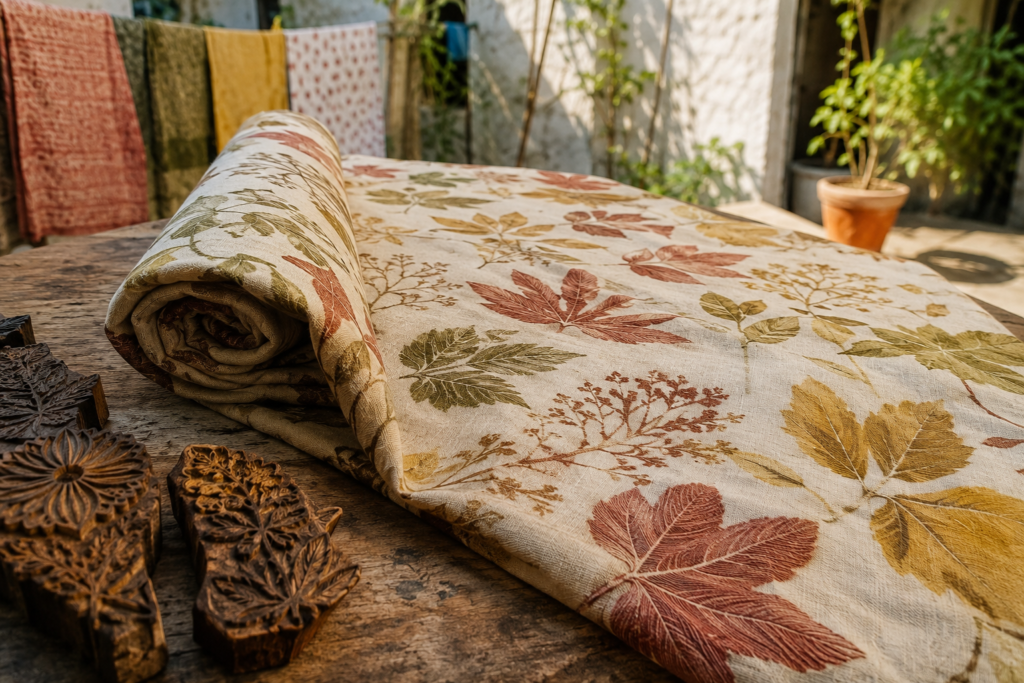
If you’ve ever picked up a fallen leaf and wondered why it left a stain on your palm, you’ve already brushed against the idea behind eco printing. In Bagru — a small artisan town near Jaipur that has been synonymous with hand block printing for centuries — this old instinct has grown into a craft of its own. No chemical dyes, no printing blocks even. Just real leaves and flowers, steam, and time.
This blog walks you through what eco printing in Bagru actually is, how it’s different from the block printing Bagru is famous for, the step-by-step process, and why more designers, students, and conscious travellers are booking a seat at this workshop every month.
What Is Eco Printing?
Eco printing — also known as botanical printing — is a natural dyeing technique where leaves and flowers are placed directly on fabric and steamed or boiled until their pigments transfer onto the cloth. It’s essentially eco printing on fabric or flower printing on fabric in its simplest, most literal form: no stencils, no repeat patterns, just the plant itself making contact with the cloth. Unlike the stovetop version found in most home tutorials, the technique taught in Bagru is rooted in the same natural-dyeing knowledge local artisans already use for indigo and dabu printing.
Every leaf behaves differently. Marigold petals bleed into soft yellows, pomegranate leaves lean toward warm ochres and browns, and tannin-rich leaves can turn a deep grey-black once treated with an iron solution — the same iron (kashish) Bagru’s artisans already use for their black and dark tones in traditional dyeing. No two fabrics ever turn out the same — that’s the entire charm of it.
Bagru’s Connection to Eco Printing
Bagru’s story with colour goes back over 400 years, when the Chhipa community of dyers and printers settled near the local river and clay-rich soil — both essential for mordanting, dyeing, and washing fabric. While Bagru built its global reputation on hand block printing using hand-carved wooden blocks, the same artisans who prepare indigo vats and dabu mud-resist paste bring that same depth of natural-dyeing knowledge to eco printing, which fits naturally into Rajasthan art culture‘s long-standing relationship with plant-based colour.
So when you learn eco printing in Bagru, you’re not learning an imported hobby craft — you’re learning it from people who already understand how pigment, mordant, and fabric behave together.
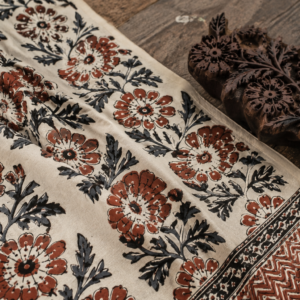
Eco Printing vs Traditional Block Printing
It’s easy to confuse the two, so here’s the simple difference:
| Block Printing | Eco Printing | |
|---|---|---|
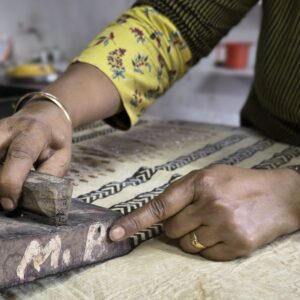
| Tool used | Hand-carved wooden blocks | Real leaves and flowers |
| Design | Repeating, planned patterns | One-of-a-kind, organic patterns |
| Dye application | Stamped by hand | Transferred through steam/heat |
| Best learned alongside | Dabu and indigo dyeing | Natural dyeing basics |
If you’re curious about the older dabu resist method Bagru is best known for, we’ve covered that in detail in our blog on how mud turns into art through Dabu printing. And if indigo fascinates you, our complete guide to natural indigo dyeing in Bagru breaks down the fermentation and vat-dyeing process.
The Eco Printing Process, Step by Step
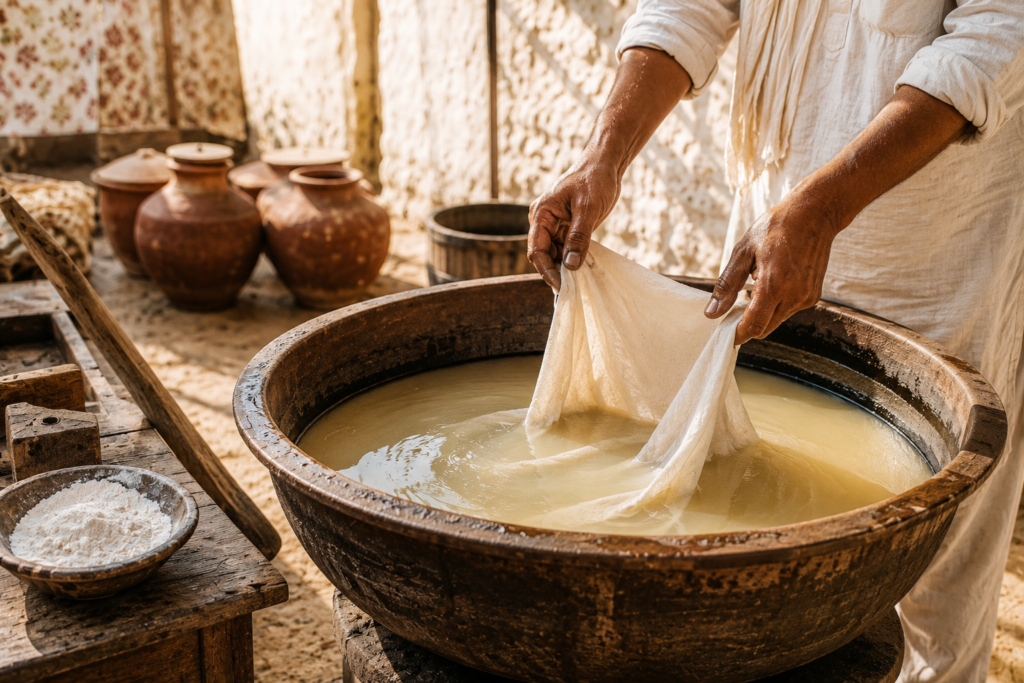
- Preparing the fabric — Natural fabric like cotton, silk, or linen is first soaked in a mordant solution (often alum, prepared the same traditional way used for indigo dyeing) so the plant pigments bind properly instead of washing.
- Arranging leaves and flowers — Fresh leaves, petals, and sometimes bark are laid out face-down on the damp fabric in a chosen pattern. This is the most creative, meditative part of the whole workshop.
- Bundling — The fabric is folded over or rolled tightly around a wooden rod, then wrapped firmly with cotton thread so every leaf stays pressed flush against the cloth. This part alone is what turns a simple craft into leaf printing art — the tightness and angle of the bundle decides how sharp or soft the final imprint will be.
- Steaming — The tightly wrapped bundle is steamed for close to an hour. Heat and moisture force the pigments out of the plant material and directly onto the fibres.
- Cooling and unrolling — This is the moment every artisan and student looks forward to — slowly unwinding the bundle to reveal the imprint. It genuinely feels like unwrapping a gift you made yourself.
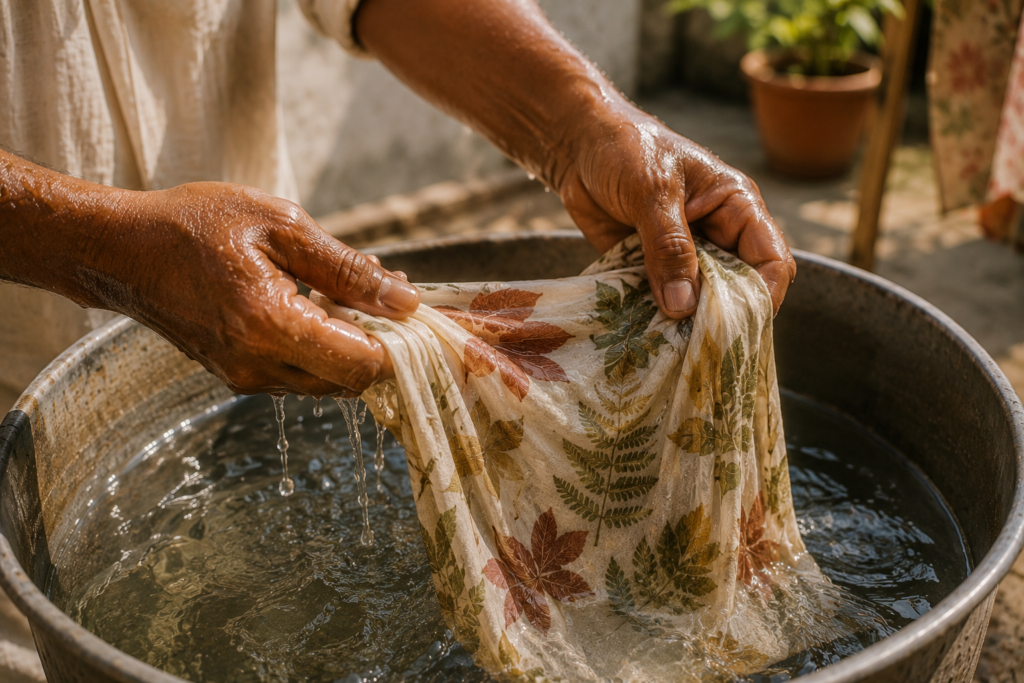
- Washing and setting — The fabric is rinsed gently with a pH-neutral wash to remove any loose plant residue while keeping the printed colour intact.
Why Eco Printing Is One of the Most Eco-Friendly Printing Methods
- Zero synthetic dyes — every colour comes directly from a plant, not a chemical vat.
- Low water use — compared to conventional textile dyeing, eco printing uses a fraction of the water, making it a genuinely sustainable textile printing method.
- Biodegradable waste — the used leaves and mordant water can go straight back into the soil.
- Skin-safe fabric — with no synthetic residue, the finished cloth is gentle even on sensitive skin, which is exactly why brands searching for eco friendly textiles are increasingly turning to techniques like this.
It’s a small-batch, slow process by nature — which is precisely why it can never be mass-produced the way chemical printing is, and why it stays valuable.
From Fabric to Framed Botanical Prints
While most people picture eco printing on scarves or stoles, the same technique works beautifully on paper and canvas too. A well-executed eco print — with clean leaf outlines and rich tannin colour — makes a striking piece of wall art on its own. Many workshop guests choose to eco-print a piece of heavy cotton or handmade paper purely to frame it later; framed botanical prints made this way carry a texture and depth that no printed reproduction can match, since the “print” is quite literally made by the plant itself.
Why Learn Eco Printing at Anaprinta
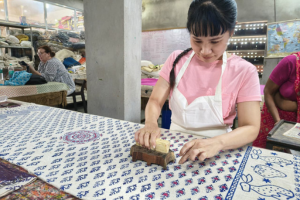
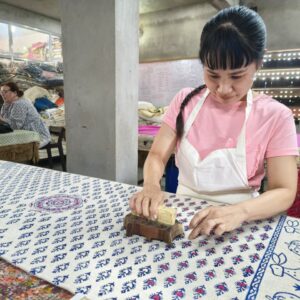
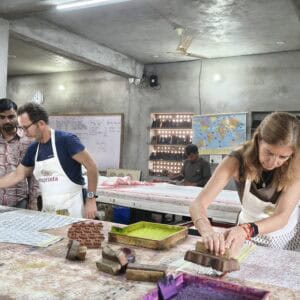
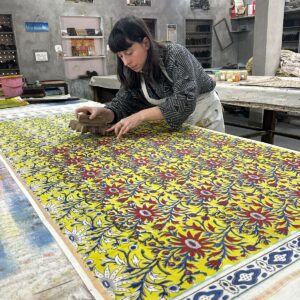
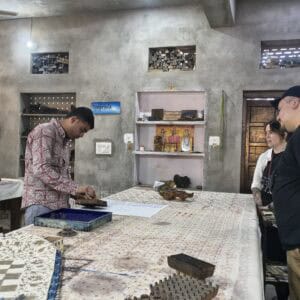
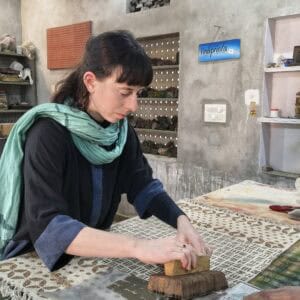
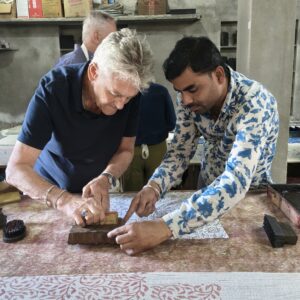
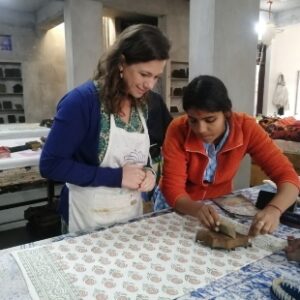
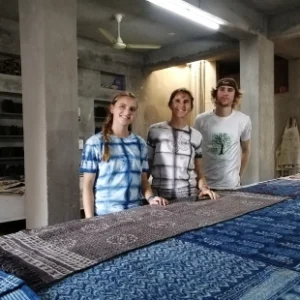
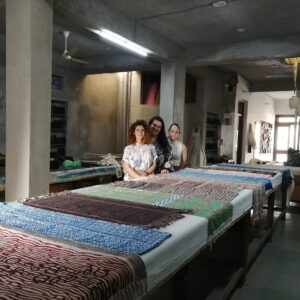
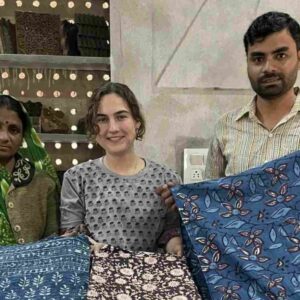
A lot of people search for a natural dyeing workshop near Jaipur without realising the most authentic version of it is happening right in Bagru. At Anaprinta, this craft isn’t taught as an isolated demo — it’s part of our One-Day Workshop 2.0, where you get to combine traditional pigment block printing with hands-on leaf-and-flower printing in the same session, guided by artisans who work with natural dyes every single day of the year, not just for tourist workshops.
Here’s what makes the experience different:
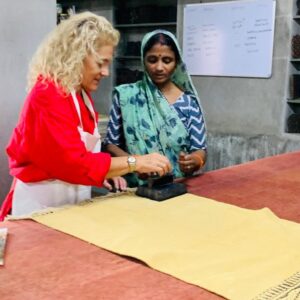
- Real artisan guidance, not a scripted demo — the same craftsmen who prepare indigo vats and dabu paste for Bagru’s export-quality textiles teach you the plant-pressing and steaming technique first-hand.
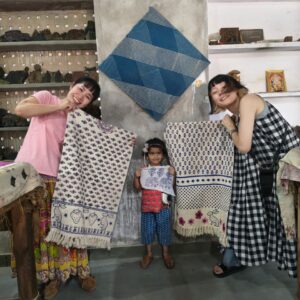
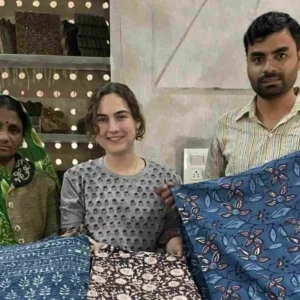
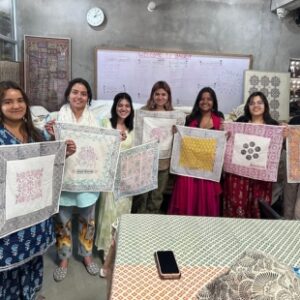
- You take home what you make — your eco-printed tote bag, scarf, or fabric piece is yours to keep, not a sample.
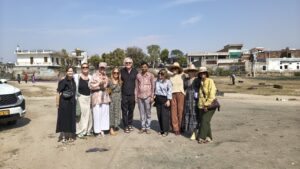
- A full day in Bagru’s “Fields of Color” — you get to walk through the very lanes where fabric dries in the sun before you even sit down to print.
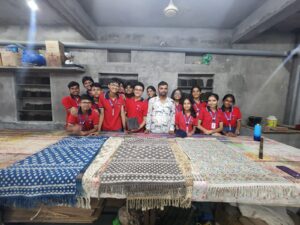
- Small groups — so every leaf placement, every fold, gets individual attention.
- Lunch included, and comfortable stay options nearby for those travelling from outside Jaipur.
Whether you’re a design student researching botanical prints for a college project, a boutique owner looking to source eco friendly printing for a new collection, or a traveller from abroad who wants a slow, hands-on day away from the usual tourist circuit — this workshop is built to work for all three.
Book the One-Day Workshop 2.0 at Anaprinta →
FAQs
Is eco printing the same as block printing? No. Block printing uses hand-carved wooden blocks to stamp repeating patterns, while eco printing uses actual leaves and flowers pressed directly onto fabric — no two results are ever identical.
Do I need any prior experience to join the workshop? Not at all. The One-Day Workshop 2.0 is designed for complete beginners, including college students and first-time visitors to Bagru.
How long does an eco-printed fabric last? With proper aftercare — gentle hand wash, no direct harsh sun for very long durations, and mild detergent — an eco-printed piece can retain its colour and pattern for years.
Can I bring my own fabric for eco printing? Yes, natural fabrics like cotton, silk, and linen respond best. Our team can guide you on fabric choice before your workshop date.
Ready to see leaves turn into art on your own fabric? Book your Bagru workshop with Anaprinta today.