Block Print

Indigo Dyeing
Block Print

What Is Indigo Printing? A Complete Guide to Natural Indigo Dyeing in Bagru (With Workshop Experience)

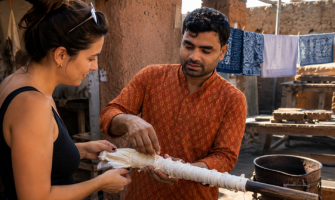
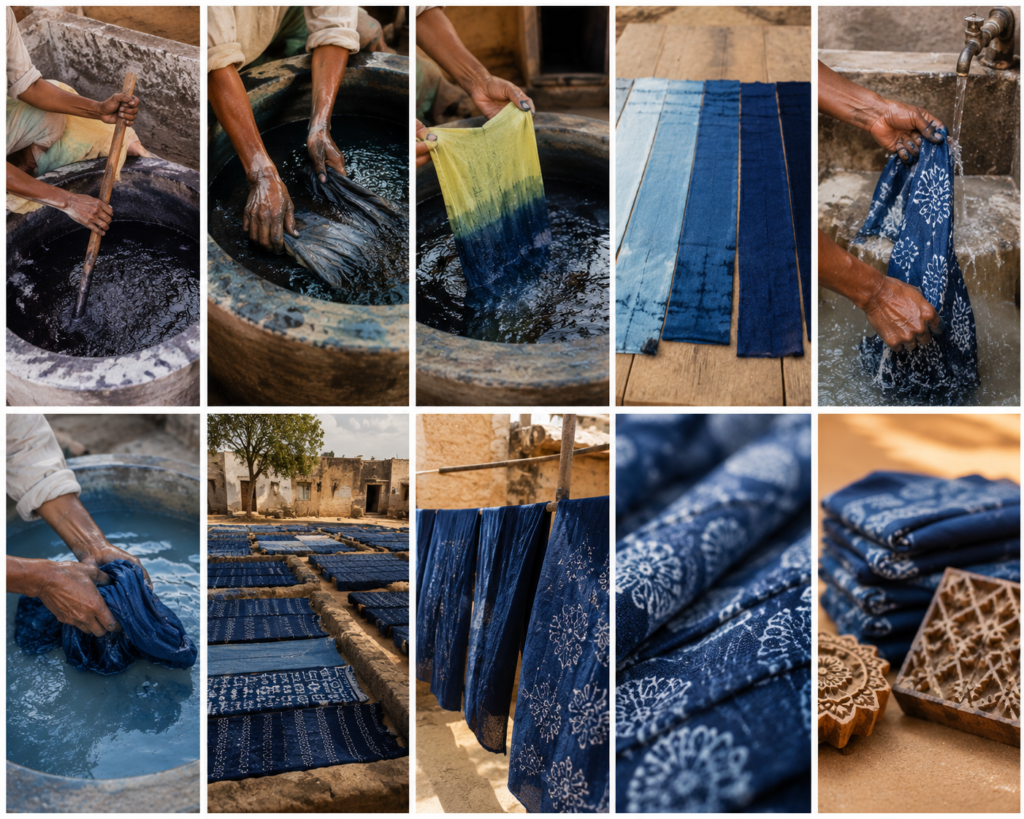
There’s a particular shade of blue you only find in Rajasthan. It’s not the blue of a swimming pool or a printed t-shirt. It’s deeper, a little uneven in places, and it seems to glow rather than just sit flat on the fabric. If you’ve ever picked up a dupatta, a cushion cover, or a bedsheet from Bagru and wondered how that colour got there, the answer is almost always the same: indigo dyeing. A lot of people search for “indigo printing” expecting to find a printing technique, something done with a block or a machine. But indigo isn’t really printed on. It’s dyed, dipped, and coaxed out of a living vat that artisans have kept alive for generations, sometimes for years at a stretch. In this guide, we’ll clear up exactly what indigo printing means, walk through the real natural indigo dyeing process as it happens in Bagru today, look at the history behind it, and show you what it’s actually like to try it yourself at a workshop here. Table of Contents What Is Indigo Printing, Really? “Indigo printing” is the term most people type into Google, but in Bagru, artisans simply call it indigo dyeing, or locally, “neel ka kaam.” The confusion is fair. Most of what Bagru is famous for is block printing, so it’s natural to assume indigo works the same way, with a carved wooden block stamping colour onto the cloth. It doesn’t. Indigo is what’s known as a vat dye. That means the fabric is dipped into a tub of prepared dye rather than having colour pressed onto it with a tool. The strange part is that the blue doesn’t even show up while the fabric is inside the vat. It develops in the open air, right in front of your eyes, the moment the wet cloth touches oxygen. That reaction is the whole magic of indigo dyeing, and no other natural colour used in Bagru behaves quite like it. Where block printing does enter the picture is when artisans combine indigo with a mud-resist paste, known locally as dabu, before dipping the fabric. Wherever that mud sits on the cloth, the indigo can’t reach the fibres underneath. Once the mud is washed off later, a pattern is left behind in white or a lighter blue against the deep indigo background. If you want to understand that resist technique in more depth, we’ve written about it separately in our post on the Dabu printing process. So, in short: what people search for as indigo printing is really indigo dyeing, often paired with a resist technique to create pattern. Understanding that difference is the first step to appreciating how much skill actually goes into it. A Short History of Indigo in Bagru Bagru, a small town roughly thirty kilometres from Jaipur, has been printing and dyeing textiles with natural colour for close to three centuries. The Chhipa community here has passed the craft down through families, refining it generation after generation, and indigo has always held a special place among the colours they work with, alongside red from madder root and black from fermented iron filings. Indigo itself has a much older story that stretches far beyond Bagru. Indigofera tinctoria, the plant most Indian indigo comes from, was cultivated across the subcontinent for thousands of years before synthetic dye existed. During the colonial period, indigo grown in India became a major global trade commodity, valuable enough that it shaped entire regional economies and, in several parts of the country, led to well-documented conflict between farmers and plantation owners. That history is heavy, and it’s worth knowing, even if it isn’t the focus of this guide. What survived after synthetic indigo arrived in the late 1800s and largely took over the commercial market was the small-scale, artisan-led practice, kept alive in pockets like Bagru, Gujarat, and a few other textile regions of India. What makes Bagru’s version of natural indigo dyeing distinct even today is how tightly it’s woven into a larger printing tradition. Most places that specialise in indigo dyeing focus purely on colour: tie-dye, shibori, solid dips. In Bagru, indigo is almost always combined with hand-carved block printing and mud-resist work, which means the finished fabric carries both a dyeing tradition and a printing tradition at once. You’re not just looking at blue cloth. You’re looking at a technique that took generations, and more than one craft, to come together. The Science Behind Natural Indigo Dyeing You don’t need a chemistry background to follow how an indigo vat works, but knowing the basics helps you appreciate why the process looks the way it does. Natural indigo comes from the leaves of the indigo plant. On their own, fresh leaves don’t dye anything blue. The pigment locked inside them, called indigotin, isn’t soluble in water in its natural state. To make it usable, artisans ferment the harvested indigo along with lime and other alkaline materials, in a process that can take days. This fermentation strips oxygen out of the mixture and converts the pigment into a soluble, pale yellow-green form, sometimes called “white indigo” or leuco-indigo. This is the part that surprises most first-timers. When you dip fabric into a working indigo vat, it doesn’t come out blue. It comes out looking murky and greenish. It’s only once the fabric is lifted into open air that oxidation happens: the leuco-indigo reacts with oxygen and turns back into insoluble blue indigotin, this time trapped permanently inside the fibres of the cloth. Watching plain white cotton turn from green to blue in under a minute, right in your own hands, is genuinely one of the most memorable parts of an indigo dyeing session. A well-maintained indigo vat can be kept alive for months, sometimes years, with regular feeding of lime, alkaline material, and rest. Experienced dyers can tell a vat’s condition just from its smell, its surface colour, and the amount of foam, often called the “indigo flower,” that forms on top before deciding whether

Natural dye printing
Block Print

Natural Dye Printing in Bagru: From Plant-Based Colors to Beautiful Hand Block Printed Fabrics

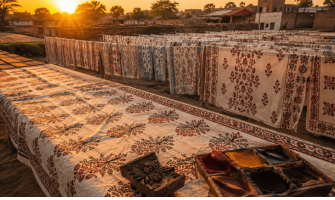
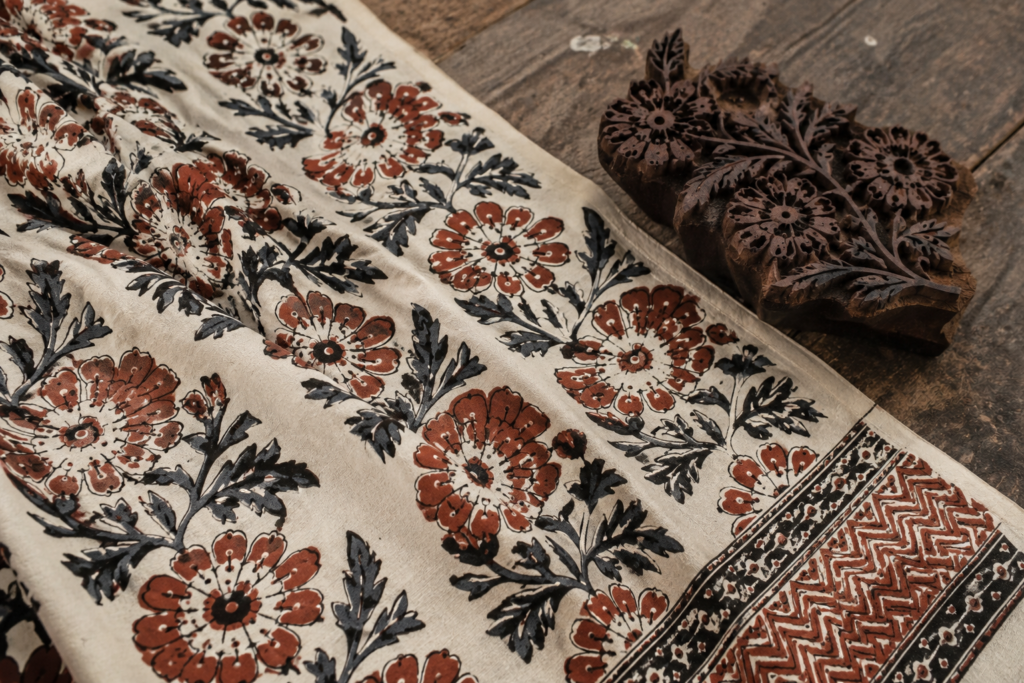
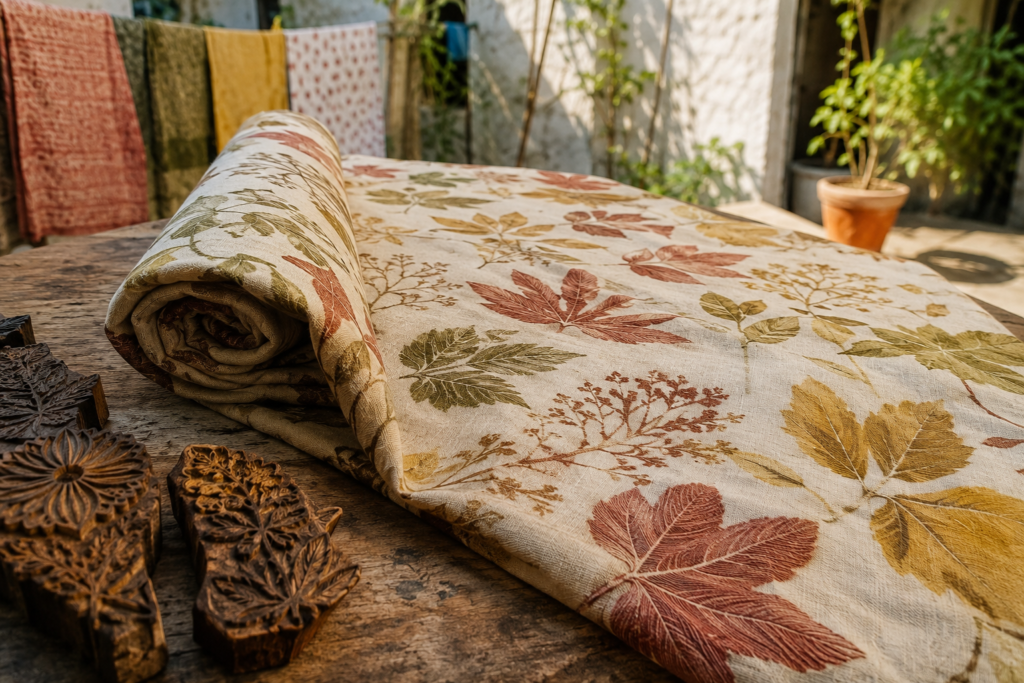
If you’ve ever picked up a hand-printed scarf or a block-printed kurta and noticed how the colors feel warm, slightly uneven, and somehow alive — that’s not a coincidence. That’s what happens when fabric is dyed with natural dye printing instead of factory chemicals. No two batches ever look exactly the same, and that’s the whole point. Close-up of a naturally dyed, hand block printed fabric folded on a wooden table, showing color variation “Hand block printed fabric dyed with natural colors in Bagru” At Anaprinta, we’ve grown up around this craft. Our studio sits in Bagru, a small town near Jaipur that has been quietly perfecting this plant-based printing tradition for centuries — long before “sustainable fashion” became a buzzword anyone talked about. In this blog, we’re walking you through what natural dye printing actually is, how it’s made from plants, flowers, and minerals, why it still matters today, and why so many people choose to learn it — or buy it — from Anaprinta and its owner, Anup Chhipa. What Is Natural Dye Printing? Natural dye printing is exactly what it sounds like — printing fabric using colors extracted from nature instead of synthetic, chemical-based dyes. Instead of a factory-made pigment, the color comes from plant roots, leaves, flowers, bark, minerals, and even insects. These natural colors are boiled, fermented, or mixed with a fixing agent (called a mordant) so they bind permanently to cotton or silk fibers. Unlike pigment printing, which simply sits on top of the fabric like a coat of paint, this plant-dyeing method actually penetrates the fibers. This is why naturally dyed fabric softens and looks even better with time and washing, instead of fading into a dull, flat version of itself. This isn’t a new trend either. It’s one of the oldest textile techniques known to human civilization, and Bagru, along with a handful of other towns in India, kept this knowledge alive when the rest of the world moved on to cheaper, faster chemical dyes. The Story Behind Bagru’s Natural Dye Printing Tradition To really understand why natural dye printing in Bagru is special, you need to know a little about the place itself. Bagru is home to the Chippa community — a name that literally means “those who print.” For 400 to 500 years, generations of this community have printed fabric using hand-carved wooden blocks and colors pulled straight from the earth. [ Artisan mixing natural dye in a large vat in a Bagru courtyard — Artisan preparing natural dye in Bagru workshop Two things are widely said to have made Bagru the right place for this craft: groundwater suited to washing and dyeing fabric without leaving stains or streaks, and access to mineral-rich clay and plant material used in dyeing and mud-resist work. Even today, if you walk through Bagru early in the morning, you’ll see courtyards lined with drying fabric, artisans mixing dye in large vats, and wooden printing blocks — some passed down through the family for decades — still doing the job perfectly. This living tradition is exactly what Anaprinta is built on. We’re not a modern brand trying to imitate an old craft — we’re part of the same community that has been doing this work for five generations. How Natural Dye Printing Actually Works — Step by Step Here’s where the real magic happens. Making a single piece of naturally dyed, hand block-printed fabric takes real time, not minutes, and every stage is done by hand. Step 1: Preparing and Washing the Fabric Raw cotton fabric being washed by hand before dyeing — “Washing raw cotton fabric before natural dyeing in Bagru”] Before any color touches the cloth, raw cotton or silk is washed thoroughly to remove starch and impurities. This step matters more than people realize — if the fabric isn’t cleaned properly, the dye won’t sit evenly, and the final colors will look patchy instead of rich. Step 2: Mordanting the Fabric soaking in a mordant solution before dyeing — “Mordanting fabric before natural dye printing process”] This is the step most people don’t know about, but it’s the reason natural fabric dye actually lasts. A mordant (commonly alum, myrobalan, or iron) is applied to the fabric before dyeing. Think of it as a bridge — it helps the natural dye molecules bond tightly to the fabric fibers so the color doesn’t wash out after a few uses. Step 3: Preparing Natural Colors from Plants, Flowers, and Miner Various natural dye ingredients laid out — indigo leaves, madder root, marigold, turmeric — Alt text: “Natural dye ingredients used in Bagru hand block printing”] This is the most fascinating part of the whole process, and it’s where natural dyes from flowers and other plant sources come in: Every one of these is a form of vegetable dye or plant-based color — nothing synthetic, nothing chemical. In fact, most of what’s used in this workshop can be traced back to a root, a flower, or a mineral you could point to in a garden or a kitchen. Step 4: Carving and Choosing the Wooden Blocks Hand-carved teakwood printing blocks arranged by pattern — “Hand-carved wooden blocks used for Bagru textile printing”] While the dyes are being prepared, artisans select hand-carved teakwood blocks based on the motif they want — florals, paisleys, geometric patterns, or traditional Bagru designs passed down through generations. A single block can take days or weeks to carve. Step 5: Block Printing the Fabric Artisan pressing a wooden block onto fabric by hand — “Hand block printing fabric with natural dye in Bagru”] The carved block is dipped into the natural color and pressed firmly onto the cloth by hand, one impression at a time. There’s no machine involved — an artisan lines up every stamp by eye, using years of muscle memory to keep the pattern consistent. Step 6: Dyeing in the Natural Dye Bath Fabric being dipped into an indigo dye vat “Fabric dipped in natural indigo dye bath

The Dabu Printing Process
Block Print

The Dabu Printing Process, Step by Step: How Mud Turns Into Art

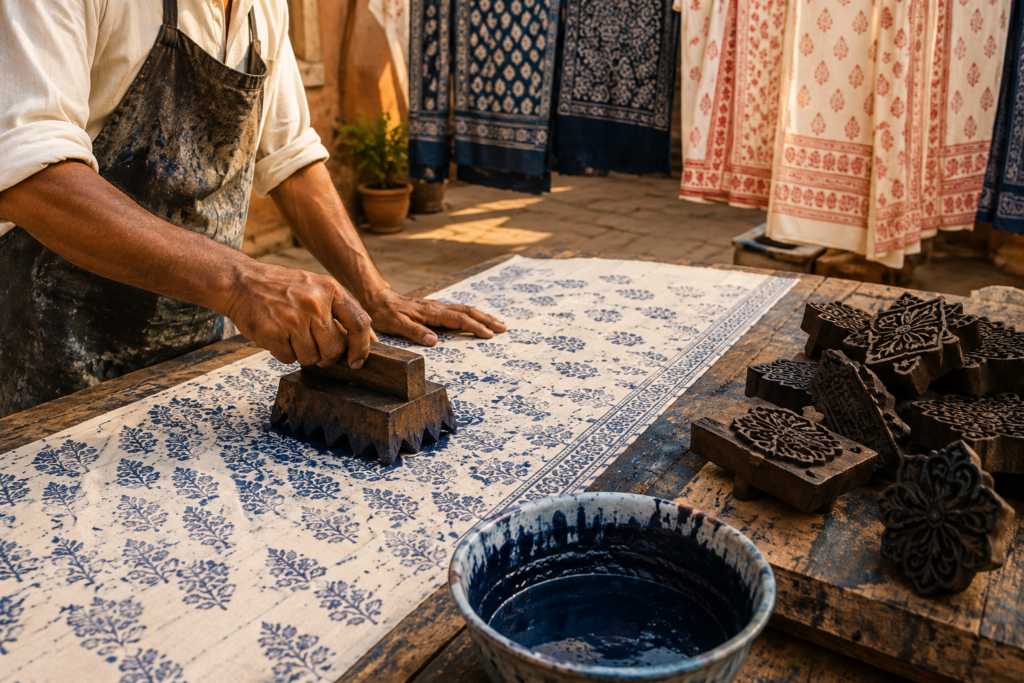
If you’ve ever run your hand over a piece of fabric with soft, earthy patterns and wondered how something so beautiful could come from something as simple as mud — you’re not alone. The dabu printing process is one of the oldest and strangest-sounding textile techniques in India, and once you see it up close, you’ll never look at a block-printed scarf the same way again. At Anaprinta, our workshops in Bagru, Jaipur, exist for exactly this reason — to let people watch, touch, and actually do what generations of artisans have done by hand for centuries. In this blog, we’re walking you through the entire dabu printing process, from raw fabric to finished cloth, so you know exactly what happens before a piece of Bagru hand block printing ever reaches your hands — or before you try it yourself. What Is Dabu Printing? Dabu printing is a resist-printing technique that uses mud, not wax or chemicals, to block dye from certain parts of the fabric. The word “dabu” comes from the Hindi word dabana, meaning “to press” — because the mud paste is literally pressed onto the cloth using hand-carved wooden blocks. Unlike regular block printing, where color goes directly onto the fabric, dabu block printing works in reverse. The mud paste protects (or “resists”) certain areas from the dye, so when the fabric is dipped in a dye bath, those covered areas stay untouched. Once the mud is washed away, the original fabric color peeks through in beautiful, organic patterns — no two pieces ever turning out exactly alike. It’s slow. It’s messy. And it’s one of the most satisfying things you’ll ever watch — or try. A Short History of Bagru Printing To understand dabu, you first need to understand Bagru — a small town about 30 km from Jaipur that has been the beating heart of Bagru print for over 300 years. The Chippa community, whose name literally means “those who print,” settled here generations ago because of two things the land offered: clean river water and mineral-rich soil, both essential for natural dyeing and mud-resist work. Walk through Bagru even today, and you’ll see fabric drying on rooftops, artisans working in open courtyards, and the same wooden blocks — some passed down through three or four generations — still being used exactly as they were decades ago. This isn’t a revived craft or a tourist reenactment. It’s a living tradition, practiced daily by families who’ve never known another trade. This is also what makes Bagru hand block printing so different from mass-produced prints you find in stores — every mark, every slightly imperfect line, is proof that a human hand made it. The Dabu Printing Process, Step by Step Here’s where it gets interesting. The entire dabu printing process takes several days from start to finish, and every single step is done by hand. Let’s break it down. Step 1: Preparing the Fabric Before any printing begins, the raw cotton fabric is washed thoroughly to remove starch, oils, and impurities. This step, called desizing, ensures the fabric absorbs dye evenly later on. The cloth is then left to dry completely under the sun — a theme you’ll notice throughout this entire process. Step 2: Carving and Choosing the Blocks Each pattern begins as a hand-carved wooden block, traditionally made from seasoned teakwood. Master carvers spend days — sometimes weeks — chiselling out a single design. Artisans choose blocks based on the motif they want: florals, paisleys, geometric borders, or traditional Bagru patterns passed down for generations. Step 3: Making the Dabu Mud Paste This is the heart of the technique. The dabu paste is made by mixing natural dye printing ingredients — black clay (locally sourced mud), gum, lime, and wheat husk — into a thick, smooth paste. Getting the consistency right takes years of experience. Too thin, and it won’t resist the dye properly; too thick, and it cracks and flakes off the fabric. Step 4: Block Printing the Resist The carved wooden block is dipped into the mud paste and pressed firmly onto the fabric by hand. The artisan repeats this motion across the entire length of cloth, lining up each impression by eye — no machines, no guides, just years of muscle memory. Step 5: Sprinkling Sawdust Immediately after printing, fine sawdust is sprinkled over the wet mud paste. This might look like a small detail, but it’s crucial — the sawdust keeps the paste from smudging and helps it hold its shape while drying. Step 6: Dyeing in Natural Colors Once the mud has dried completely, the fabric is dipped into a natural dye bath — often indigo for deep blues, or dyes derived from madder root, turmeric, and pomegranate rind for warmer earthy tones. Wherever the mud paste sits, the dye simply cannot reach the fibers underneath. Step 7: Washing and Revealing the Pattern This is the most exciting part to watch. The dried, dyed fabric is taken to washing tanks, where it’s soaked and then beaten against stone slabs to loosen and remove the dried mud. As the paste washes away, the resisted pattern slowly reveals itself underneath — almost like uncovering a hidden design. Step 8: Final Drying Under the Sun The finished fabric is laid out flat under open sky one final time, allowing it to dry naturally and set the colors. This sun-drying step is also what gives dabu-printed textiles their distinct, slightly weathered texture that machine-printed fabric simply cannot replicate. From soaking the raw cloth to the final dry, a single length of dabu fabric can take anywhere from 3 to 7 days to complete, depending on the weather and the depth of color required. Why Learn Dabu Printing at Anaprinta Reading about the process is one thing — but there’s nothing quite like getting your hands into the mud paste yourself. That’s exactly the experience we’ve built at Anaprinta, part of Fields of Color, our home base in Bagru. Our dabu block printing

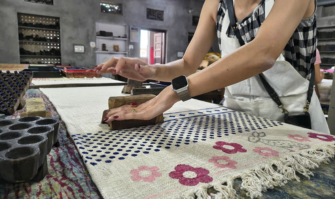
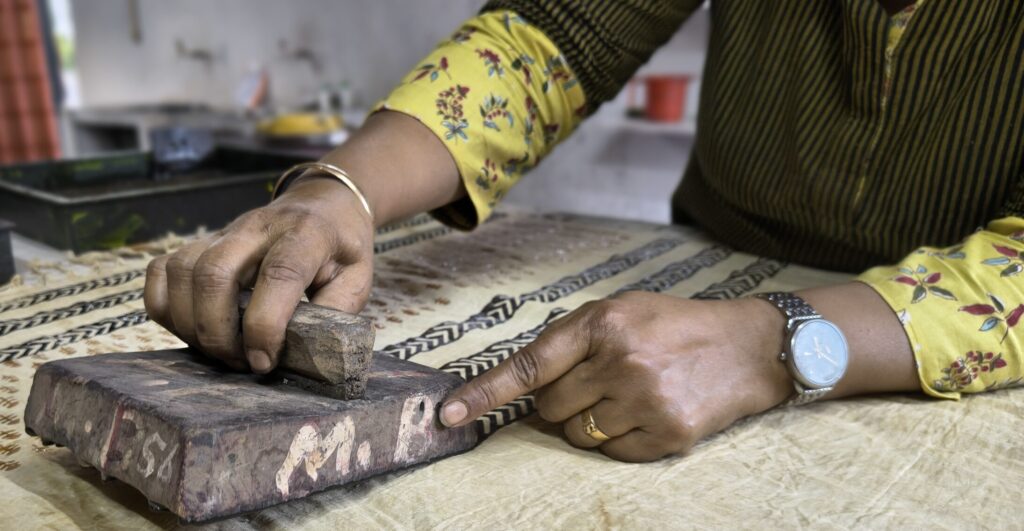
Artisan hand block printing on cotton fabric during a traditional Bagru workshop near Jaipur
Block Print

Why Every Traveler Should Join a Hand Block Printing Workshop in Bagru

Discover the Real Rajasthan Through Block Printing When people plan a trip to Jaipur, they usually picture forts, busy bazaars, royal palaces, and great food. And yes, all of that is worth seeing. But there’s one experience that goes a little deeper — joining a hand block printing workshop in Bagru. Bagru is a small heritage village just 30–40 minutes from Jaipur. It’s famous across the world for one thing: traditional textile printing done entirely by hand. Local artisan families still use hand-carved wooden blocks and natural dyes, the same way their families have for generations. Instead of just buying a souvenir from a shop, imagine printing your own fabric with your own hands, guided by someone who has done this their whole life. That’s a very different kind of memory to bring home. Whether you’re traveling solo, as a couple, with your family, or you’re a designer looking for inspiration — a block printing workshop is genuinely one of the best things to do in Jaipur. Why Is Bagru So Famous for Block Printing? Bagru isn’t just another stop on the tourist map. It’s a living craft village that has kept one of India’s oldest textile traditions alive for over 400 years. Every design here is stamped by hand, one block at a time — nothing is machine-made. And that’s actually the charm of it. The small variations you see from print to print aren’t mistakes. They’re proof that a real person made it, not a machine. People travel from the USA, UK, Australia, France, Germany, Italy, Japan, and plenty of other countries just to see this craft up close. For many, it ends up being one of the most memorable parts of their entire India trip. What Actually Happens in a Block Printing Workshop? A lot of tourist activities are fun for an hour and then forgotten. This one tends to stick with people. Here’s what a typical workshop covers: A Bit of History First You’ll learn how Bagru’s printing tradition started and why it became so well known. The motifs you’ll be working with — flowers, leaves, geometric shapes — all come from traditional Rajasthani art, and there’s usually a story behind each one. Meeting the Artisans This part is honestly the highlight for most people. These aren’t performers putting on a show — they’re real craftspeople whose families have done this work for generations. Hearing them talk about their craft adds something a museum simply can’t give you. Learning the Actual Technique Your instructor walks you through the whole process step by step: By the end, you’ll understand just how much patience and skill goes into something that looks simple from the outside. Something You’ll Actually Keep Most souvenirs end up in a drawer somewhere. A piece of fabric you printed yourself is different — it means something, because you made it. Depending on the session, you might print a tote bag, a scarf, a table runner, napkins, a cushion cover, or a length of cotton fabric. Good for Every Kind of Traveler Solo travelers — a relaxed, creative way to meet local people and slow down for a couple of hours. Couples — printing matching designs together makes for a genuinely fun, low-pressure date. Families — kids love stamping the wooden blocks, and parents get a hands-on way to introduce them to Indian culture. Designers and artists — if you work in textiles, fashion, or interiors, seeing this process up close teaches you things no book can. Photographers and content creators — the wooden blocks, drying fabrics, and village setting make for some genuinely great photos. More Than Sightseeing — Real Participation Most Jaipur itineraries are built around forts and markets, and that’s fine. But adding a Bagru workshop changes the trip into something more personal. Instead of just seeing Rajasthan from behind a camera, you’re actually part of it for a couple of hours — the creativity, the history, the conversation with artisans, all of it. That’s why so many international travelers now list it among their favorite Rajasthan cultural experiences. It’s Also Good Tourism More travelers today want their trip to actually help the places they visit, not just pass through them. Joining a block printing workshop does exactly that — it directly supports the artisan families keeping this craft alive. Every workshop supports: Why People Choose Anaprinta Not every workshop is run the same way. At Anaprinta, the goal is to make it feel personal — not like a staged demo for tourists. You’ll work directly alongside artisan families who’ve been practicing Bagru block printing for generations, in small groups, away from the noise of the city. What sets it apart: If you’re planning a trip, you can check available dates and book your workshop directly on the Anaprinta website. What to Expect on the Day 1. Welcome and a bit of background — a short introduction to Bagru’s history and why it’s still such a respected craft today. 2. A look at the wooden blocks — hand-carved, often with floral or geometric designs, each one with its own story. 3. Step-by-step guidance — choosing a design, preparing the fabric, mixing colors, and printing your pattern. 4. Printing your own piece — this is the fun part. No two prints ever come out exactly the same. 5. Taking it home — instead of a shop-bought souvenir, you leave with something you made yourself. Best Time to Visit Bagru Bagru can be visited year-round, but here’s a rough guide: You can easily combine your visit with other Jaipur sightseeing to make it a full day out. A Few Tips Before You Go Frequently Asked Questions Is this workshop good for beginners? Yes, completely. No prior experience needed — the artisans guide you through everything. How long does it take? Usually around 2–3 hours, depending on the session. Can children join? Yes, it’s a family-friendly activity. What will I actually make? Depending on the workshop, you could print a tote bag, scarf, table

Scroll to Top

Get in Touch for Stunning Custom Clothing Prints!